
If you’ve searched “best jobs for women,” you’ve probably already scrolled past a few lists built around slogans instead of numbers: “follow your passion,” “the sky’s the limit,” that kind of thing. Passion doesn’t pay the mortgage on its own. What does help is knowing which jobs actually hire people in their 40s and 50s, what they realistically pay, and how long it takes to get from where you are now to an offer letter.
So this list is built differently. Every job below either uses skills you likely already have from raising a family, running a household budget, managing a team, or working in an office for a decade, or it has a clear, short path in. Where I can, I’ve used the U.S. Bureau of Labor Statistics’ national median wage data (May 2025) instead of the vague “up to $80K!” numbers you’ll see on recruiting sites. Medians are the middle of the pay range, half of people in that job earn more and half earn less, so treat them as a starting reference point, not a promise.
The fastest career changes don’t start from zero. They start from what you’re already good at, renamed.
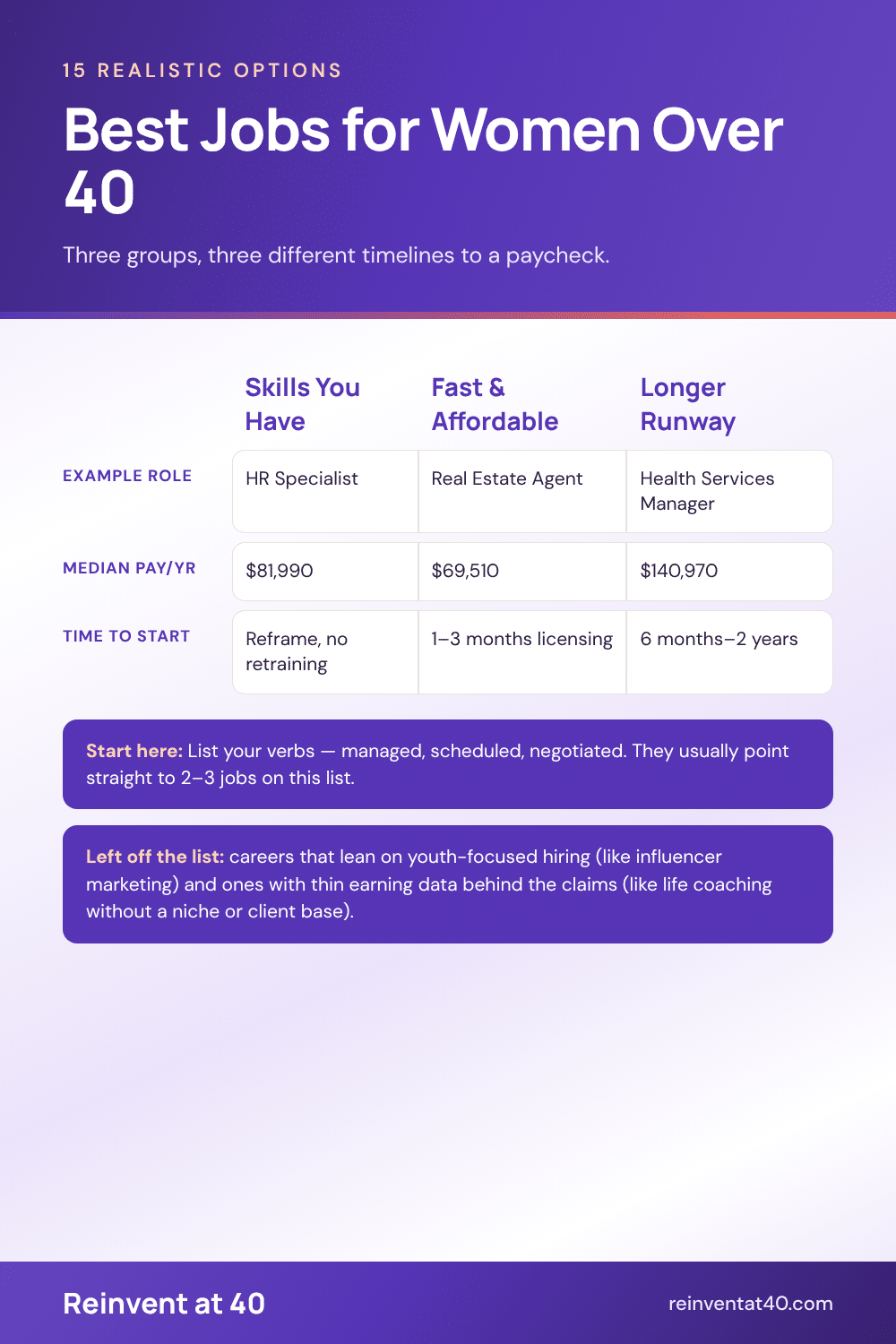
I also left a few things off this list on purpose. Careers that lean heavily on youth-focused hiring in practice, even when nothing on paper says so, like influencer marketing or entry-level retail, aren’t here. Neither are jobs that sound appealing but have thin real-world data behind their earning claims, life coaching without a niche or client base being the classic example. Every role below has a national wage figure or a documented, repeatable path to income behind it.
At a glance: three groups, three timelines
- Skills you already have — fastest transition, reframing over retraining.
- Fast, affordable path in — weeks to a few months, licensing or short certification.
- Worth the longer runway — six months to two years, higher pay ceiling.

Jobs that use skills you already have
These are the fastest transitions for most career changers, because you’re reframing experience rather than starting from zero.
Human resources specialist
If you’ve ever handled hiring, benefits, scheduling, or conflict between coworkers, you’ve already done HR work informally. Human resources specialists handle recruiting, onboarding, benefits administration, and employee relations. The national median wage is $81,990 a year, according to BLS. Many companies will hire for HR coordinator or generalist roles with a bachelor’s degree in any field plus relevant experience, and the SHRM-CP certification (a few months of self-study, roughly $400-$500 in exam fees) strengthens an application without a degree.
Executive assistant
This role rewards exactly the skills that get undervalued at home: juggling calendars, anticipating problems before they happen, and keeping a dozen moving parts on track. Executive secretaries and executive administrative assistants earn a median $62,550 a year. The path in is usually a strong resume plus references, not a credential, which makes it one of the more accessible entries on this list if you’re returning after a gap.
Project manager
If you’ve planned a wedding, a home renovation, or a school fundraiser with a real budget and deadline, you’ve run a project. Project management specialists earn a median $110,740 a year, the highest on this list among roles that don’t require a graduate degree. The Project Management Professional (PMP) certification carries real weight with employers, but it does take a few months of study and requires documented project experience to sit for the exam, so it’s a step you add after landing an entry-level coordinator role, not before.
Training and development specialist
Companies constantly need people to build onboarding programs and run staff training, and years of explaining things patiently to kids, employees, or volunteers is genuinely relevant experience. The median wage is $75,550 a year. A background in teaching, HR, or even leading community workshops translates well here.
Customer success manager
This is the growth path for anyone who’s worked in customer service, retail management, or client relations. Customer service representatives have a median wage of $39,090, but customer success manager roles, which focus on retaining and growing existing accounts rather than answering support tickets, typically pay well above that once you have a year or two of experience. It’s a realistic stepping-stone role if you’re rebuilding a resume after time away.
Jobs with a fast, affordable path in
If you need income sooner rather than later, these roles have licensing or certification tracks measured in weeks or a few months, not years.
Real estate agent
Real estate licensing courses typically run 60-180 hours depending on your state, plus a state exam, and can often be completed in one to three months while working another job. Real estate sales agents earn a median $69,510 a year, though income is commission-based and uneven in the first year while you build a client base. The flexibility appeals to women balancing school pickup or caregiving, since you set your own showing schedule.
Insurance sales agent
Similar structure to real estate: a state licensing exam (life and health, or property and casualty, depending on what you sell), typically a few weeks of prep, and then you’re hireable. Insurance sales agents earn a median $81,480 a year. Many agencies pay a base salary during your first months while you build a book of clients, which softens the commission-only risk that pure real estate work carries.
Bookkeeper
If you’ve managed a household budget, small business books, or a nonprofit’s finances, bookkeeping is a natural next step. Bookkeeping, accounting, and auditing clerks earn a median $44,090 a year, and a QuickBooks Online ProAdvisor certification (free to earn, a few weeks of self-paced study) makes you immediately more hireable, including for remote and freelance bookkeeping work. For the full path, including what to charge and how to land your first client, see how to become a bookkeeper without a degree.
Substitute teacher
Most districts require only a bachelor’s degree, sometimes not even that, plus a background check, and you can often start within a month of applying. Substitute teachers earn a median $46,420 a year, and the schedule flexibility (you choose which days to work in most districts) makes this a common bridge job while training for something else, or a long-term fit if you like working with kids without the year-round demands of a full teaching certification.
Virtual assistant
This is the option with the lowest barrier to entry and the most variable pay, since it’s typically freelance work rather than a single employer with a BLS wage code. Virtual assistants handle email management, scheduling, research, and administrative support remotely for entrepreneurs and small businesses. Rates for beginners commonly start in the $20-$35/hour range on freelance platforms and rise with specialization (social media management, bookkeeping, executive support). It’s a genuinely good starting point if you want to test remote work before committing to a bigger reskilling investment, and it pairs well with the bookkeeping and executive assistant skills above. For the exact steps to land your first client, see how to become a virtual assistant with no experience.

Jobs worth the longer runway
These pay more, on average, but expect six months to two years of additional credentialing.
Medical and health services manager
If you’ve worked in healthcare administration, insurance, or even managed a medical office’s front desk for years, this is a realistic reach role. Medical and health services managers earn a median $140,970 a year, the highest wage on this list, but most positions require a bachelor’s degree (often in healthcare administration or business) and several years of healthcare-related experience, sometimes a master’s for larger facilities. Worth pursuing if you’re already adjacent to healthcare, not a cold-start career change.
Interior designer
For women with a genuine eye for space and materials, this combines creativity with client-facing work. Interior designers earn a median $74,540 a year. Most states require either a degree from a CIDA-accredited program or a combination of an associate degree plus work experience before you can sit for the NCIDQ certification exam, so budget one to two years if you’re starting without a design background.
Technical writer
If you can explain a complicated process clearly, this field pays well and is remote-friendly. Technical writers earn a median $96,970 a year. A portfolio matters more than a specific degree; building a few writing samples (documentation for a piece of software, a how-to guide, a policy manual) is often enough to start applying, especially if you’re coming from a technical or regulated industry like healthcare, finance, or engineering.
Marketing specialist
Market research analysts and marketing specialists earn a median $89,490 a year. If you managed communications for a school, a nonprofit board, or a small business’s social media, you have real marketing experience, it just needs to be reframed on a resume with results (attendance numbers, follower growth, event turnout) rather than described as volunteer work.
Paralegal
Paralegals and legal assistants earn a median $69,700 a year. Certificate programs typically run four months to a year, and some firms will train an organized, detail-oriented hire without a certificate if you have relevant experience, such as prior legal secretary work or a background that involved reading contracts or compliance documents closely.
A note on where to start
Don’t pick from this list based on pay alone. The fastest, most sustainable career changes match a job to skills you already have, which is why I grouped this list the way I did. A woman who spent fifteen years managing a household of five and volunteering as PTA treasurer is closer to a bookkeeping or project management career than she thinks, even if her resume shows a gap instead of a job title.
Start by listing what you actually did in your last role, or your last unpaid one, in verbs: managed, scheduled, negotiated, trained, reconciled. Those verbs usually point straight at two or three jobs on this list. If you want a more structured process, our complete guide to changing careers at 40 walks through how to audit your existing experience before you choose a direction.
And if a hiring manager is going to ask about a gap in your resume no matter which job you pick, it’s worth preparing that answer before you start applying rather than during an interview. Here’s how to explain a resume gap without over-apologizing for it.
And if a diploma is the specific thing standing between you and a paycheck, not just a general sense of “what next,” our roundup of high-paying jobs without a degree or experience covers five roles that hire and train people from scratch, no industry background required. If you’re specifically on the far end of this age range, best jobs for women over 50 narrows this list down to six roles that research on older workers actually backs, picked for lighter physical demands and real schedule flexibility. And if a shorter week matters more than anything else, part time jobs for women over 50 covers five roles where part-time hours are the normal way the job is staffed, not something you have to negotiate. And if age bias, not just the mechanics of a career change, is what’s slowing down your search, our guide to ageism in job search covers the concrete moves that actually help.
If you’re past 50, two narrower lists may fit better: remote jobs for women over 50, where every role is home-based by default, and part-time jobs for women over 50, where short hours are how the job is normally staffed.
Frequently asked questions
What’s the best job for a woman over 40 with no college degree?
Real estate agent, insurance sales agent, bookkeeper, substitute teaching, and virtual assistant work are all realistic without a four-year degree. Real estate and insurance require passing a state licensing exam rather than a degree, and virtual assistant work has no formal credential requirement at all, just a track record you build over time. For a longer list built specifically around this question, including trades and short-certification options not covered here, see the best careers to start at 40 without a degree.
Which of these jobs can I do remotely?
Virtual assistant, bookkeeper, technical writer, and many marketing specialist roles are commonly remote or hybrid. Customer success manager and training and development roles increasingly offer remote options too, though this varies a lot by employer. For a shorter list built specifically around remote-first roles, see remote jobs for women over 50.
How long does a career change like this actually take at 40 or 50?
For the roles in the “fast, affordable path” group, most women can go from decision to first paycheck in one to four months. The “longer runway” roles typically take six months to two years, mostly because of degree or certification requirements. The “skills you already have” group is usually fastest of all if your resume is reframed well, since you’re not learning a new skill set, you’re translating one.
Do I need to go back to school full-time?
Rarely, for this particular list. Most of the credentials mentioned above are self-paced certifications, licensing exams, or short certificate programs you can complete while working. The main exceptions are medical and health services management and, in some states, interior design, both of which usually require a degree.
I’ve been out of the workforce for years. Does that rule any of these out?
No, but it does mean you’ll want a clear, honest explanation ready for the gap, which is a separate skill from the career change itself. Executive assistant, bookkeeper, substitute teaching, and virtual assistant work tend to be the most forgiving of a resume gap, since they weight current skills and reliability over a continuous employment history.
Which of these pays the most without years of retraining?
Project manager, at a median $110,740 a year, offers the best pay-to-training ratio on this list if you already have some project or operations experience to point to. Insurance sales and HR specialist roles are close behind and typically faster to enter.