
People throw around “pivot” and “career change” like they mean the same thing, and in casual conversation they mostly do. Then someone says she wants to pivot, and two sentences later she’s describing leaving healthcare entirely for graphic design. Those are two different projects wearing one word. Knowing which one you’re actually planning changes almost everything: how long it takes, how much retraining you need, and how much of a financial cushion the transition requires. The complete guide to changing careers at 40 covers the full five-step process either path eventually needs. This one is about figuring out which path you’re on before you start following it.
A pivot keeps you in roughly the same field and moves you sideways into a role that uses skills you already have, repositioned for a different context. A hospital administrator who moves into healthcare operations consulting is pivoting. So is a teacher who moves from classroom instruction into corporate training. The industry knowledge stays useful. The day-to-day work can change quite a bit, but the vocabulary, the network, and most of the credibility already built still apply.
What a full career change actually means
A full career change swaps the field itself, not just the role inside it. A hospital administrator who leaves healthcare to sell real estate isn’t pivoting anymore. She’s starting over in a market where fifteen years of hospital experience barely register on a resume. That doesn’t make it the wrong move; plenty of people do exactly this and land well. It just means the plan needs a longer runway, because industry knowledge built over a decade or more in one field rarely transfers cleanly to a different one.
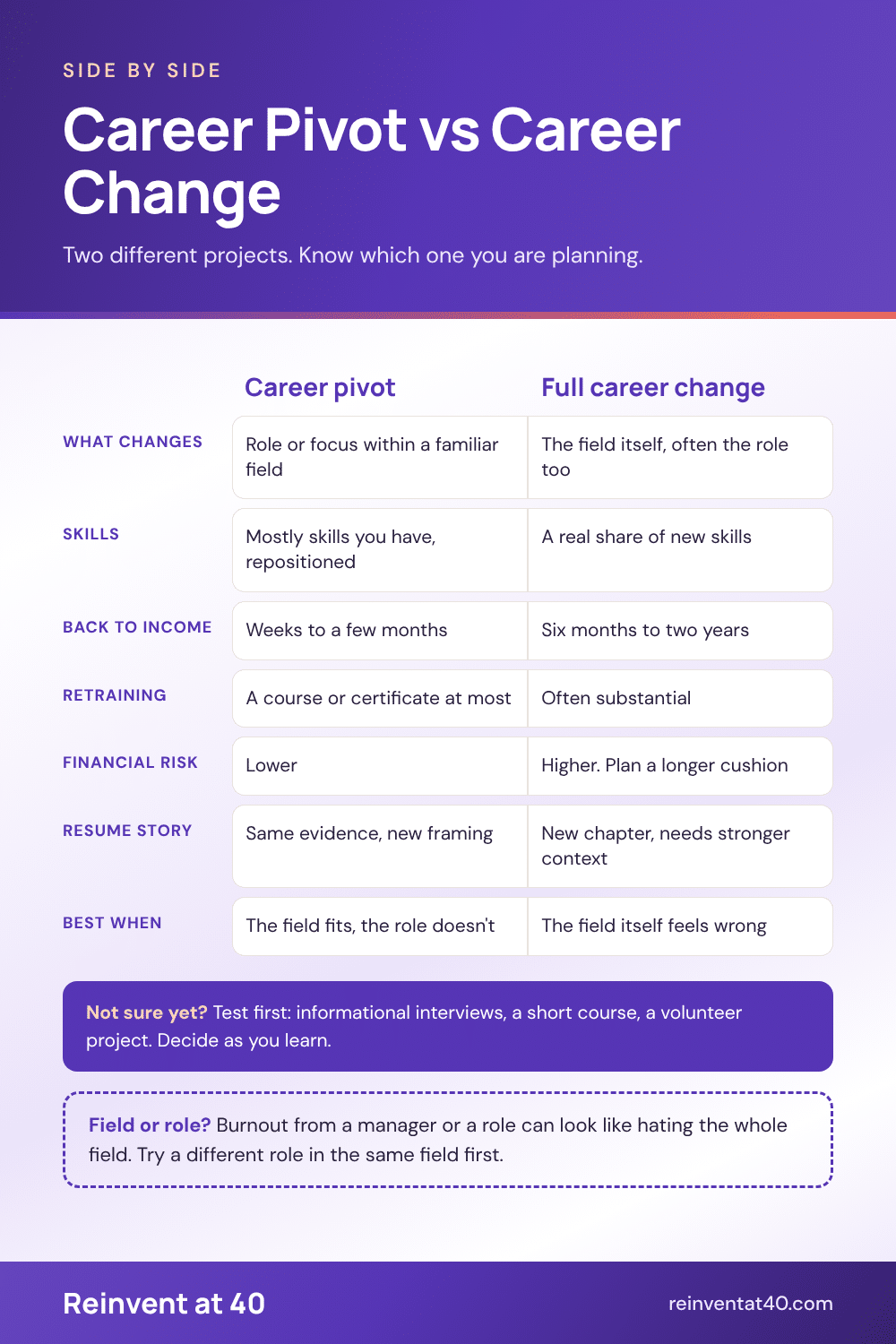
Career pivot vs career change, side by side
| Dimension | Career pivot | Full career change |
|---|---|---|
| What changes | Role or focus within a familiar field | The field itself, often the role too |
| Skills needed | Mostly skills you already have, repositioned | A real share of new skills |
| Time to comparable income | Weeks to a few months | Six months to two years |
| Retraining | Minimal: a course or certificate at most | Often substantial, sometimes a full program |
| Financial risk | Lower | Higher, plan a longer cushion |
| Resume story | Same evidence, different framing | New chapter, needs stronger context |
| Best when | The field still fits, but the role doesn’t | The field itself feels wrong, not just the role |

Which one do you need? Four questions to ask yourself
Is it the field or the role that’s wearing you down?
This is the question that trips up the most people. Burnout from a difficult manager or a role that stopped fitting your strengths often gets misdiagnosed as hating the entire field. Before deciding to leave an industry, test whether a different role inside it, or at a different company, actually solves the problem. If the frustration follows you into every version of the work you can imagine, that’s a stronger signal for a full change.
How much runway do you actually have?
A pivot usually gets you back to comparable income within a few months, because you’re not starting from zero. A full change routinely means a pay cut for a year or more while you rebuild credibility somewhere new. Work out, honestly, how many months of expenses are covered and how much of a pay cut is tolerable before committing to either path. This isn’t the place for optimistic rounding.
Would a short test actually tell you enough?
Pivots are cheap to test: a project inside your current job, a short certificate, a handful of informational interviews with people already doing the role. Full changes usually need a longer test, closer to a part-time class over several months or a volunteer role, because the learning curve is steeper and a weekend workshop won’t show you what the daily work is really like.
What does your resume actually need to accomplish?
A pivot resume needs to translate: same evidence, different framing, so a hiring manager in the new role recognizes the skills underneath a different job title. A full change resume needs to do more work, explaining credibility in a field with no direct track record, usually by leading with transferable outcomes instead of chronology. The step-by-step plan for changing careers at 40 covers exactly how to rebuild a resume this way.

What each one looks like in practice
Picture a marketing manager with twelve years inside a manufacturing company. She doesn’t leave marketing. She moves into marketing for a different industry, say healthcare technology, keeping the skill set and swapping the context. A few months of networking and one certificate in healthcare marketing can be enough to make that move, sometimes at higher pay. That’s a pivot: same muscle, new gym.
Now picture an accountant with eighteen years in the field who decides the actual problem is accounting itself, not the company. She retrains as a UX researcher, a field where her analytical background helps but doesn’t replace the missing experience. A move like this can take a year or more, with a real pay cut before the old salary is back. That’s a full change, and if you’re in the same spot and not sure where to land, 15 realistic job options for women over 40 is a reasonable place to start narrowing it down.
You don’t have to choose blind
The testing step in the complete career change guide, informational interviews, a short course, a volunteer project, works for both paths, and it’s worth doing before committing to a label. Plenty of people start out convinced they’re pivoting and realize six months in that the whole field needs to go, or the reverse: they think they need a full overhaul and discover a lateral move inside their current industry solves it. The label matters less than the testing. Decide as you learn, not before.
Frequently asked questions
Is a career pivot easier than a full career change?
Can a pivot turn into a full career change later?
Do I need a new degree for a career pivot?
How do I know if I’m underestimating how big the change actually is?
A career pivot and a career change solve different problems, and confusing them wastes time on the wrong preparation. Figure out which one is actually needed first. Everything else, the testing, the resume, the timeline, follows from getting that one decision right.