
If you’ve spent the last few months rewriting your resume to hide an eight-month stretch of unemployment, or debating whether to list “2019–2022” instead of the actual months so a gap disappears into the margins, you’re not being paranoid. You’re responding to a real signal: hiring managers notice gaps. What most job seekers get wrong is what that noticing actually means, and what to do about it.
Here’s the short version: a gap on your resume is a fact, not a confession. The job is to explain the employment gap clearly, once, and move on. Not to apologize for it, and not to pretend it didn’t happen.
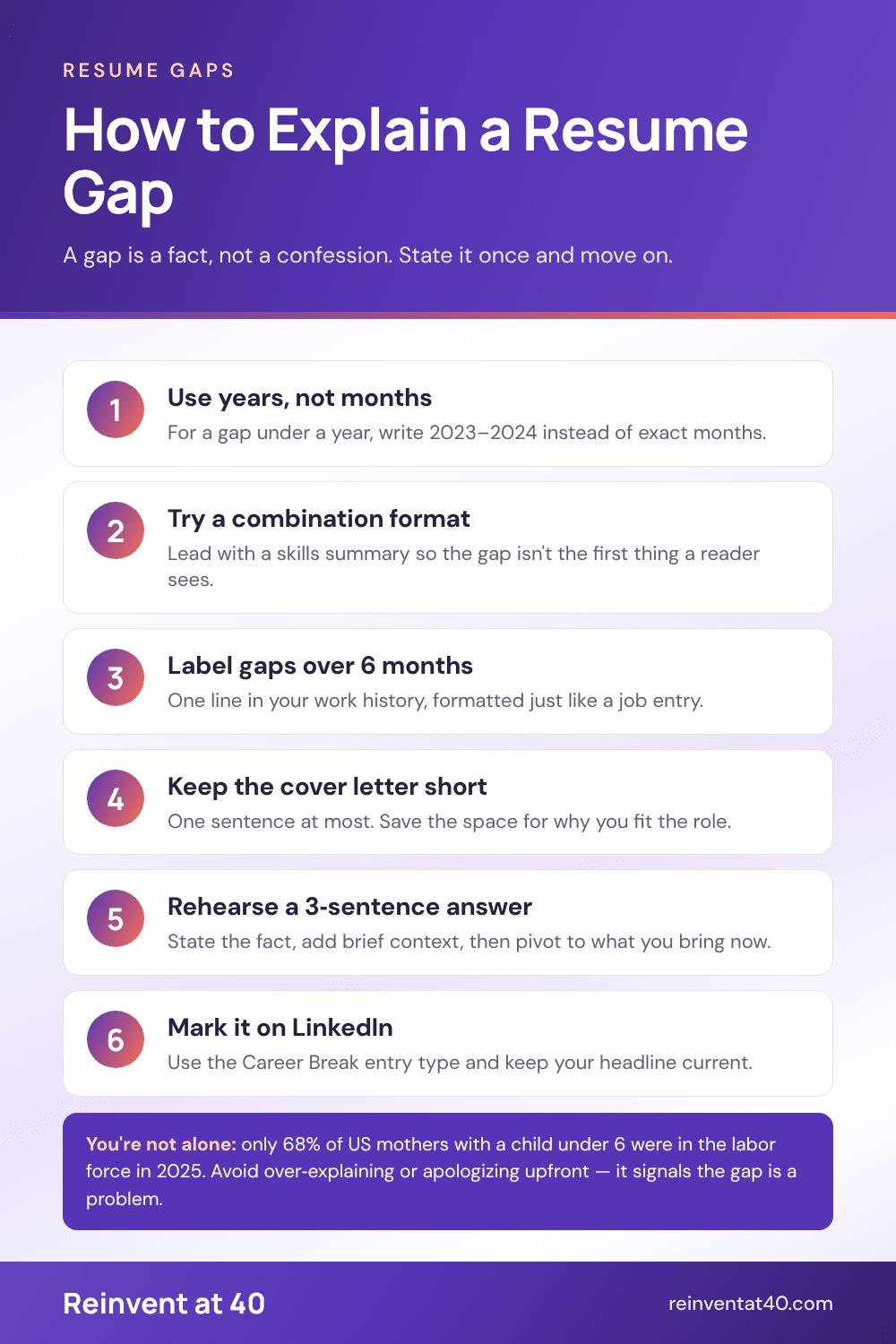
Gaps are more common than the silence around them suggests
Part of what makes a resume gap feel so exposing is that almost nobody talks about their own. Everyone assumes their situation is the unusual one.
It isn’t. According to the Bureau of Labor Statistics, only 68.0% of mothers with a child under age 6 were in the labor force in 2025, compared with 78.2% of mothers whose youngest child was between 6 and 17. Married mothers with a child under age 3 had a labor force participation rate of just 64.5%. Read that the other way around: at any given moment, roughly a third of mothers with young kids are not working outside the home. That’s not a fringe pattern. That’s a huge, ordinary population of women who will, at some point, be applying for a job with a gap on their resume.
Caregiving is the biggest driver, but it’s far from the only one. Layoffs, health issues (your own or a family member’s), a spouse’s relocation, a return to school, burnout that required an actual break rather than a vacation. All of these produce the same line on a resume: a stretch of time with no employer listed. The reasons are different. The resume line looks the same.
What a hiring manager is actually asking when they see a gap
Most job seekers assume a hiring manager sees a gap and thinks “red flag.” More often, they’re asking three narrower questions, usually in this order:
- Is this person’s experience still current? A two-year-old skill set in a fast-moving field is a bigger concern to them than the gap itself.
- Is there a pattern here, or a one-time event? A single 18-month gap after a layoff reads very differently than four separate gaps across ten years.
- Will this person actually show up and stay? This is the real anxiety underneath most of the others, and it has nothing to do with your competence.
None of these questions require an apology. They require information. Your job is to supply it efficiently enough that the hiring manager stops wondering and starts reading the rest of your resume.
For a fuller picture of what hiring managers weigh beyond the gap itself, currency of your skills, confidence in the interview, and the logistics questions they don’t say out loud, see our breakdown of what employers actually look for when women return to work.

How to handle it on the resume itself
Use years, not months, if the gap is under a year. “2023–2024” is standard and nobody expects month-level precision unless you’re applying somewhere unusually formal. This isn’t deception; it’s the normal convention for resume dates.
Consider a combination format instead of a strict reverse-chronological one. A combination resume leads with a skills and experience summary, then lists work history below it in a shorter, less prominent block. It doesn’t hide a gap, but it stops the gap from being the first thing a reader’s eye lands on, because the first thing they read is what you can actually do.
Label the gap if it’s over six months, in one line. You don’t need a paragraph. A single entry in your work history, formatted the same way as a job entry, does the work:
Family Caregiver, 2023–2024
Managed full-time care for a parent following a medical diagnosis; resumed full-time work in [industry] in 2024.
Or, for a layoff-driven gap:
Career Transition, 2022–2023
Following a company-wide layoff, completed [certification/course] and consulted on [type of project] while conducting a focused job search.
This does three things at once: it accounts for the time, it signals you weren’t idle, and it stops the gap from looking unexplained, which is what actually worries hiring managers more than the gap itself.
Skip it in the cover letter unless it’s directly relevant. A cover letter is prime real estate. Spending a paragraph justifying a gap usually gives it more weight than it needs. One sentence, if any, is enough. Save the rest of the space for why you’re a strong fit for this specific role.

What to say in the interview
This is where most of the anxiety actually lives, and where a short, rehearsed answer does the most good. Three sentences, delivered without hesitation, almost always outperforms a long, hedging explanation.
A caregiving gap:
“I stepped away from full-time work in 2023 to care for my mother during her treatment. She’s doing well now, and I’m ready to return to full-time work — I actually stayed current with [industry/field] through [specific way: reading, a course, freelance work, volunteering] during that time.”
A layoff:
“My previous role was eliminated in a company-wide restructuring in 2022, along with about 15% of the department. I used the time to [complete a certification / consult / focus my search], and I’m looking for a role where I can [specific value you bring].”
A burnout-driven or unspecified break:
“I took a deliberate break after several intense years to reset, and I’m returning because I’m genuinely ready for full-time work again — this isn’t a stopgap for me.”
Notice what’s missing from all three: “I’m sorry,” “unfortunately,” “I know this looks bad,” or any variation on those. Say the fact, add one line of context, and pivot to what you bring now. If the interviewer wants more detail, they’ll ask a follow-up question. Most won’t.
What not to do
Don’t over-explain. The longer the explanation, the more it signals that you think the gap is a problem. Hiring managers take their cue from your tone as much as your words.
Don’t lie about it. Fabricating a job title or inventing a period of “independent consulting” that didn’t happen is easy to unravel in a background check or a casual reference call, and it turns a manageable gap into a trust issue, which is a much harder thing to recover from in an interview.
Don’t front-load the apology. Opening with “I know my resume has a gap, and I want to explain” puts the interviewer on alert before you’ve said anything substantive. Let the explanation stand on its own; skip the preamble.
Don’t assume every interviewer will ask. Plenty won’t, especially if your resume already accounts for the time. Rehearsing an answer you never need to use is fine. Volunteering it unprompted, every time, isn’t necessary.
How to handle it on LinkedIn
Your resume and your LinkedIn profile don’t have to say exactly the same thing, but they shouldn’t contradict each other either. A few adjustments make the gap look intentional rather than accidental:
Use the “Career Break” entry type under the Experience section rather than leaving a blank stretch between two jobs. LinkedIn built this specifically because so many profiles were showing unexplained gaps, and recruiters now recognize it as a standard entry, not a workaround.
Keep your headline current even during the gap. “Marketing Director | Returning to full-time work in 2026” tells anyone who lands on your profile exactly where things stand, without them having to piece it together from your work history.
Stay visible while you’re out. Commenting on posts in your field, sharing an article, or writing a short post about what you’re learning keeps your profile from looking dormant for the entire length of the gap. It also means that when a recruiter does look at your activity, the most recent thing they see isn’t from three years ago. For the rest of the profile, headline, About section, photo, recommendations, our step-by-step plan to update your LinkedIn profile after 40 covers the full overhaul.
Rebuilding your network before you apply
A gap makes cold applications harder, because you’ve lost the internal referrals that come from being currently employed somewhere. The fix isn’t more applications. It’s reconnecting with people before you need something from them.
A referral doesn’t erase the gap. It just means nobody’s looking at it anymore.
A short, low-pressure message works better than a long one:
“Hi [Name], I’ve been out of full-time work for the past [year] taking care of [reason], and I’m starting to look at roles in [field] again. I’d love to hear how things are going at [company] if you have 15 minutes sometime in the next few weeks — no pressure if now’s not a good time.”
Send this to five or six people you worked with before the gap, not fifty strangers on LinkedIn. People who already know your work are far more likely to mention an opening, forward your resume internally, or simply tell you the truth about whether their team is hiring. That kind of warm lead does more for you than another round of cold applications, and it sidesteps the resume-gap question almost entirely, because someone is vouching for you before a hiring manager ever opens the document. If the person you’re reconnecting with works in a field you’re only just exploring rather than one you already know, that conversation can turn into a full informational interview instead of a quick catch-up, and it’s worth treating it that way.
Different gaps, different framing
- Caregiving: keep it factual and brief.
- Layoff or closure: name it plainly, no hedging.
- Health: “a health issue that’s fully resolved” is enough.
- School or certification: list it like a job, not a gap.
- Extended search: name what you did during it.
- Divorce: needs planning more than apology.
- Multiple gaps: one sentence covering the whole period beats four half-explanations.
Caregiving (child, parent, or family member’s illness): This is the most common reason and, encouragingly, the one hiring managers are most likely to have encountered themselves or on their team. Keep the explanation factual and brief; there’s no need to detail the medical situation. If your time away was specifically as a stay-at-home parent, our guide on returning to work after being a stay-at-home mom covers the practical first steps in more depth.
Layoff or company closure: This one requires the least framing of any gap type. It’s understood as something that happened to you, not a choice you made. Naming the layoff plainly, without hedging, tends to land better than dancing around it.
Health (your own): You’re not obligated to disclose a diagnosis. “I took time for a health issue that’s fully resolved” is a complete, accurate, and sufficient answer.
Return to school or certification: This is close to a non-issue if you list the program as you would a job. Employers generally read this as initiative, not absence.
Extended job search after a layoff or relocation: Be specific about what you did during the search, whether that’s a certification, freelance or contract work, or volunteering, even if it was part-time. “I was job searching” alone reads as passive; “I was job searching while completing X” reads as active.
Divorce or separation: A gap or career slowdown tied to a divorce needs the least apology of any type on this list, and often the most practical planning. If rebuilding your career is tangled up with rebuilding your finances on a new timeline, our guide to starting over after divorce covers that bigger picture, not just how to phrase the gap.
Multiple gaps over several years: This is the one case where a little more framing helps, because a single gap reads as an event and several gaps can read as a pattern. If the gaps share a cause, several years of caring for aging parents with breaks in between, for instance, say so directly rather than addressing each one separately: “Between 2019 and 2023, I moved in and out of full-time work while managing care for my father; that responsibility has now been resolved.” One sentence covering the whole period is stronger than four separate half-explanations.
The gap is one line on the page; the rest of the resume matters just as much. Resume tips for older workers covers format and length, and what employers actually look for when women return to work shows how hiring managers read a career break. If the gap was for raising children, see returning to work after being a stay-at-home mom.
Frequently asked questions
How long of a gap actually raises concern for employers?
There’s no universal threshold, but most career advisors point to roughly six months as the point where it’s worth addressing directly rather than leaving unexplained. Below that, most hiring managers won’t ask at all.
Should I list “Career Break” as a job title on LinkedIn?
It’s become common enough to be a reasonable option, particularly since LinkedIn added a dedicated “Career Break” entry type in 2022. It works well combined with one line describing what the time involved.
Will an applicant tracking system automatically filter me out for having a gap?
Most ATS platforms filter on keywords and required qualifications, not on chronological continuity. A gap by itself won’t trigger an automatic rejection. What can hurt you is a resume with dates removed entirely or reformatted in a way that looks evasive rather than simply gapped.
Do I need to explain a gap in a cover letter if I’ve already addressed it on the resume?
No. Repeating it in both places usually just draws more attention to it. Address it once, in whichever place makes more sense for your situation, and let it stay addressed.
Is it better to leave a short gap off the resume entirely?
For gaps under a few months, many career advisors say it’s fine to let the year ranges absorb it (for example, listing a job as ending in “2022” rather than a specific month). For anything longer, an unexplained missing chunk of time tends to raise more questions than a labeled one.
Should the gap change how I approach salary negotiation?
Not on its own. A gap affects your negotiating leverage far less than your most recent title, your certifications, and how well you can speak to what you’d bring to the role. If anything, undervaluing yourself because of the gap is the more common mistake; anchor your number to the market rate for the role, not to how long you’ve been out.
If you’re rebuilding your resume and rethinking your direction at the same time, not just accounting for the gap but figuring out what comes next, our guide to changing careers at 40 walks through that process step by step.
And if what you’re really asking is how long the whole process takes, not just how to word the gap, see our realistic timeline for reentering the workforce after 40 for a phase-by-phase breakdown. And if part of what’s unresolved is which job to actually target once you’re back in the market, our roundup of realistic jobs for women over 40 is built around roles that don’t penalize a gap.
A resume gap is one line among many on a document meant to get you an interview, not a confession that needs absolution. State it, contextualize it briefly, and let your actual qualifications do the rest of the work.