
Search "work from home jobs no experience" and you’ll land in one of the messiest corners of the internet: real postings from real companies, sitting right next to data-entry scams, envelope-stuffing schemes that have existed in some form since before the internet, and "hiring now, $40/hour" ads that lead to a $200 "starter kit" fee. This is one of the highest-volume searches in the entire career-change space, and also one of the most exploited. Here’s how to tell the two apart, and where the real opportunities actually are.
Why this search term attracts so many scams
Work-from-home job scams thrive on exactly the situation a lot of women reading this are in: needing income, wanting flexibility, and searching with urgency. Scammers optimize their ads for the same keywords real employers use, which means the search results mix legitimate postings with fraudulent ones almost indistinguishably at a glance. The Federal Trade Commission tracks job scams as one of the most reported fraud categories every year, and remote "no experience needed" roles are consistently among the most impersonated.
The good news: once you know the specific red flags, telling them apart gets much easier.
Red flags that mean walk away
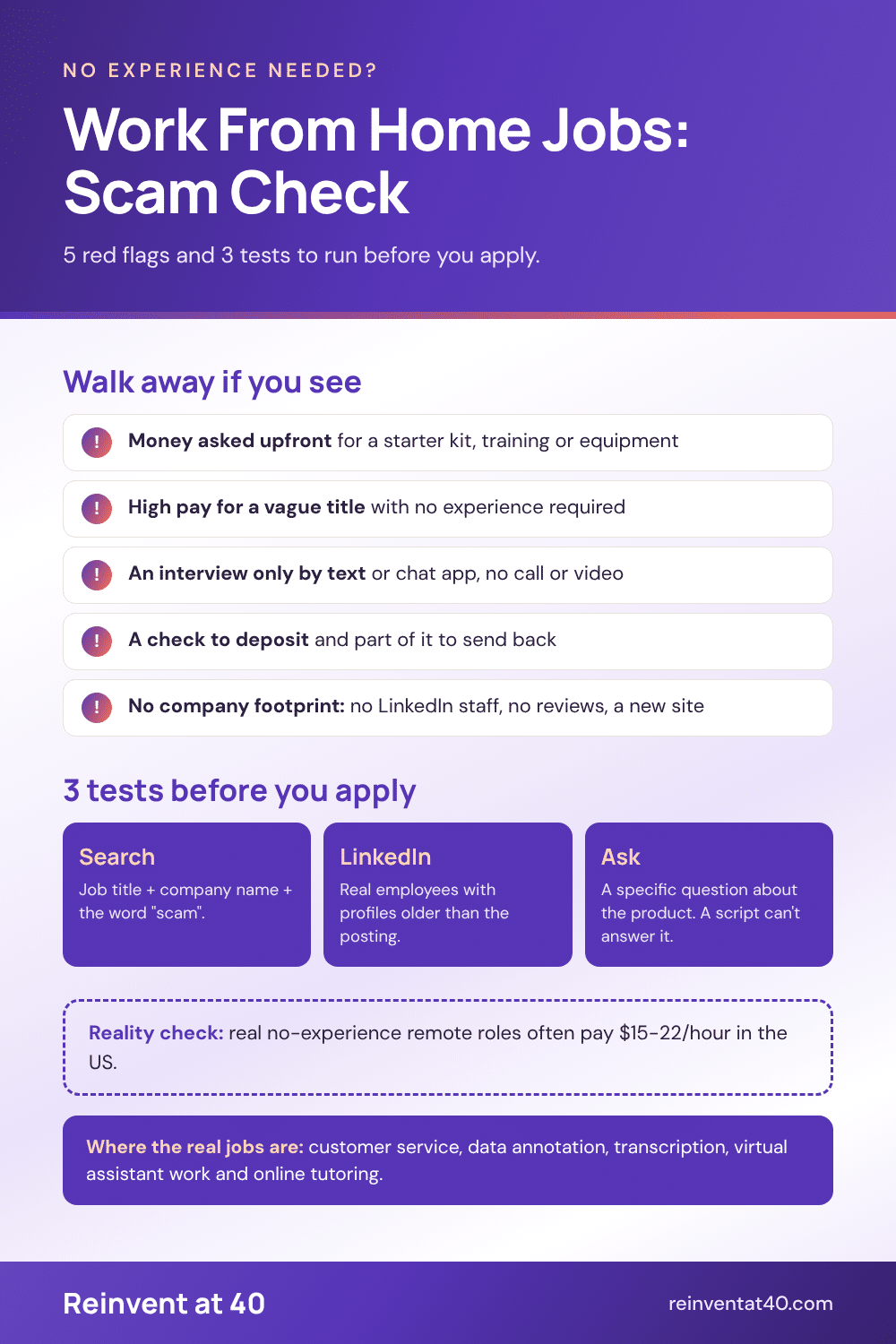
Any request for money upfront. Legitimate employers do not charge you for training materials, a "starter kit," background check fees paid directly to them, or equipment, before you’ve been hired and started earning. If a "job" asks for payment before you begin work, it’s a scam, without exception.
Vague job titles paired with unusually high pay for no experience. "Data entry specialist, $35-45/hour, no experience required" almost never exists in the real market. Real entry-level remote roles with no experience requirement typically pay in line with entry-level in-person work in the same field, not dramatically above it.
Interviews conducted entirely over text or chat apps. Legitimate companies, even fully remote ones, generally conduct at least a video or phone interview before hiring. An "interview" that happens entirely through a messaging app, with no video and no verifiable company presence, is a serious warning sign.
Being asked to deposit a check and send part of it back. This is a classic overpayment scam, common in "mystery shopper" or "personal assistant" job scams. No legitimate employer asks a new hire to process checks and wire money to a third party as an early job task.
A company with no verifiable footprint. Search the company name plus "reviews" and check it against the Better Business Bureau and LinkedIn. A company with no employees listed on LinkedIn, no reviews anywhere, and a website that’s only a few months old (checkable through a free WHOIS lookup) is worth extreme caution.

Where the real no-experience remote jobs actually are
Legitimate work-from-home roles that don’t require prior experience do exist, they’re just less flashy than the scam ads promise.
Customer service and support roles with companies that maintain fully remote support teams (airlines, retailers, software companies, and BPO firms like Concentrix or TTEC) regularly hire entry-level remote agents. These usually require a quiet workspace, reliable internet, and a background check, not prior call-center experience. From October to December, many of the same employers also post seasonal work-from-home jobs, a low-commitment way to try remote work.
Data annotation and content moderation. Companies training AI systems need large numbers of people to label data, moderate content, or evaluate model outputs. Platforms like Appen, Lionbridge, and TELUS International (formerly TELUS AI) hire for these roles regularly, often part-time and fully remote, with no degree required.
Transcription and captioning. Entry-level transcription doesn’t pay especially well per hour at first, but it’s genuinely no-experience and fully remote, and it can be a stepping stone toward better-paying specialized transcription (legal or medical) once you’ve built speed and accuracy.
Virtual assistant work, especially for solo entrepreneurs and small businesses who need basic admin, email, and scheduling support and don’t require specialized experience to start. If this direction interests you, the full breakdown of how to become a virtual assistant covers the actual first-client process.
Tutoring and teaching English online, through platforms connecting tutors with students, which often require only fluency and a reliable connection rather than a teaching credential, depending on the platform and subject.
How to verify a specific posting before you apply
Before submitting any application or personal information, run through this quick check:
- Search the exact job title plus the company name plus the word "scam." If a pattern of complaints exists, it will usually surface here.
- Look up the company on LinkedIn and confirm real employees exist, with profiles that predate the job posting by months or years.
- Check whether the same exact posting appears on multiple sketchy job board mirrors with slightly different company names, a common scam pattern.
- Confirm the application goes through a real company careers page or a recognized job platform (Indeed, LinkedIn, the company’s own site), not just a text message or personal email address.
- If they offer a phone or video screen, ask a specific question about the company’s product or service. A real hiring manager can answer; a scam recruiter reading a script usually can’t go off-script.

Setting realistic expectations on pay and hours
Genuine no-experience remote roles typically pay in line with entry-level in-person work in the same category, often in the $15-22/hour range in the US depending on the role and location, sometimes higher for specialized skills like bilingual support. Anyone advertising dramatically more than that for genuinely no-experience work is very likely selling something rather than hiring for something. That doesn’t mean remote work can’t eventually pay well, it means the "no experience" entry point is, realistically, an entry point, with room to grow once you’ve built a track record.
If you have a long career behind you, “no experience” roles may undersell you: remote jobs for women over 50 covers roles that pay for what you already know. If a role search stalls, it is worth widening the lens: building financial independence after a career change and knowing how to negotiate once you are in a role both apply just as much to a remote job as to any other.
Frequently asked questions
How do I know if a "no experience needed" remote job posting is legitimate?
Check for a real company presence (LinkedIn employees, verifiable reviews, an established website), a normal interview process that includes at least a phone or video conversation, and no request for money at any stage. Legitimate postings describe specific job duties; scam postings tend to focus heavily on the pay and flexibility instead.
What’s a realistic hourly rate for a work-from-home job with no experience?
Most legitimate entry-level remote roles in the US pay in a similar range to comparable in-person entry-level work, commonly in the mid-teens to low twenties per hour depending on the role, location, and whether it’s employee or contractor status.
Are work-from-home jobs on sites like Indeed or LinkedIn safer than ones found through social media ads?
Generally yes. Major job platforms have some vetting and reporting mechanisms, and scam postings get flagged and removed over time. Ads found through unsolicited social media messages or texts carry a much higher scam rate and deserve extra scrutiny before you engage.
Can I get a fully remote job with zero work experience at all, including no prior jobs?
It’s harder but not impossible, particularly in customer service, data annotation, and tutoring roles that emphasize specific skills (typing speed, language fluency, communication) over a formal work history. Building even a small amount of experience, through freelance platforms or short-term contract work, significantly widens your options after that first role.