
Something changed at your job and you can’t quite put your finger on why. Maybe you got left off a reorg chart everyone else saw a week early. Maybe a promotion went to someone with two years of experience instead of your fifteen. Maybe the layoff list came out and it read like a company roster from a decade ago, minus almost everyone over fifty. If part of you is wondering whether age discrimination at work is actually happening to you, and not something you’re imagining, this article is for the part of you that already suspects the answer.
This isn’t about the job search itself. If you’re the one applying and getting silence back, my guide on dealing with ageism in job search covers hiring bias specifically. This one is about what happens after you already have the job: what the law actually covers, what a severance agreement is really asking you to sign, and what a real legal case can and can’t win.
What the Law Actually Covers
The Age Discrimination in Employment Act protects workers 40 and older at companies with 20 or more employees. It bans age-based decisions in hiring, firing, pay, job assignments, promotions, layoffs, training, and benefits, and in any other term or condition of employment. Harassment counts too: a manager who keeps making comments about someone being “too old for this” or “past their prime” can create a hostile work environment even if no single remark would hold up on its own.
The harder category is the neutral policy that hits older workers harder without ever naming age. A “high performer” reorg that quietly filters on salary, where salary tracks tenure and tenure tracks age, isn’t automatically illegal just because it produces that result. The employer’s defense is that the policy rests on a reasonable factor other than age. Whether that defense actually holds up turns on the specific numbers and process behind it, not a general rule you can apply to your own situation from an article.
Why Layoffs Skew Older, and Why That’s Hard to Fight
If you’ve noticed that layoffs at your company, or at friends’ companies, tend to land more on people in their fifties and sixties than their thirties, you’re reading the pattern correctly. Cutting higher-salaried, longer-tenured staff reduces payroll costs faster than an even-handed cut across ages, and that math applies whether or not anyone involved is consciously thinking about age at all. It’s the intersection of two ordinary business incentives, which is exactly why a round of layoffs can land disproportionately on older workers without a single person deciding to target them.
That doesn’t mean nothing can be done about it. It means the useful question after a layoff isn’t “did someone say something about my age,” which almost never happens, but “what did the numbers look like across the group.” One older employee let go isn’t a pattern. A department where everyone kept on is under 45 and everyone let go is over 50 is a pattern worth documenting, even before you know what you’ll do with it.

If You’re Handed a Severance Agreement
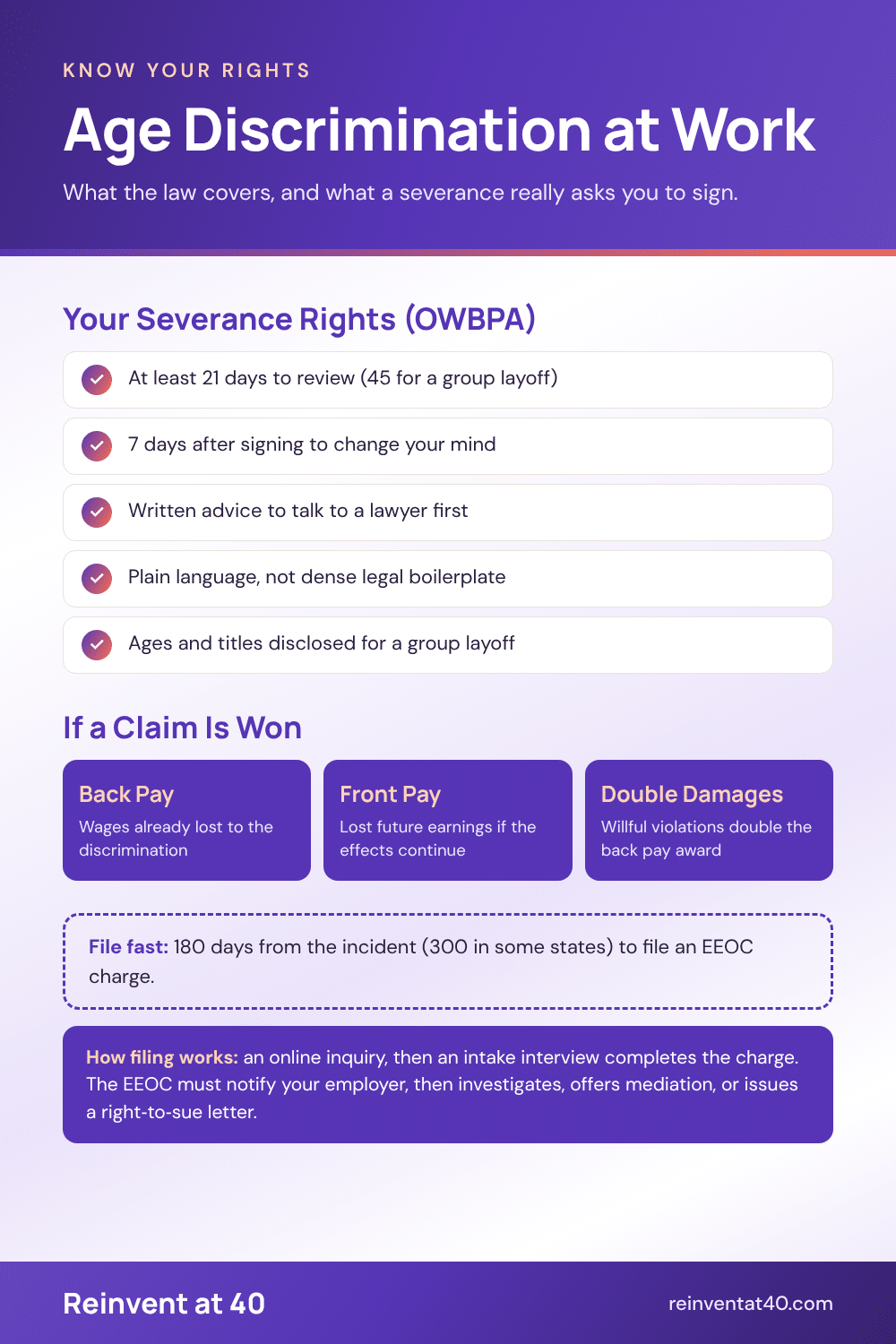
This is the one moment in the whole process where the law hands you something concrete, so it’s worth slowing down before you sign. Under the Older Workers Benefit Protection Act, a valid waiver of your right to sue for age discrimination has to meet specific conditions, and an employer that skips one of them can lose the protection the agreement was supposed to give them.
- You must get at least 21 days to consider the agreement, or 45 days if it’s part of a group layoff.
- You get 7 days after signing to change your mind and revoke it, with no penalty.
- The agreement has to tell you, in writing, to talk to a lawyer before you sign.
- It has to be written in plain language you can actually follow, not dense legal boilerplate.
- For a group layoff, the employer must disclose the job titles and ages of who was let go and who was kept, across the “decisional unit” the cuts were drawn from.
That last point matters more than it looks. It’s the one piece of the process that hands you the actual data on how the layoff broke down by age, before you sign anything away. If you’re in a group severance situation, read that disclosure before the 21 or 45 days start feeling like pressure to sign fast. It’s designed to give you time on purpose, so use it.
Keeping a Record Before You Need One
Most age discrimination isn’t provable from one incident. When it’s provable at all, it’s usually from a pattern documented over months. Save performance reviews, especially ones that contradict a “sudden” negative story your employer starts telling right before a firing. Note who else was doing comparable work and how they were treated, by name and specifics, not general impressions. Keep emails that reference age, retirement, or “fitting the culture” in ways that feel coded. None of this guarantees a case. All of it is the difference between a lawyer telling you there’s something to work with and a lawyer telling you it’s your word against theirs.
How an EEOC Charge Actually Works
Filing a charge with the Equal Employment Opportunity Commission is the required first step before an age discrimination lawsuit in almost every case. You generally can’t go straight to court. The standard deadline is 180 days from the discriminatory act. That can stretch to 300 days, but only if your state has its own age discrimination law enforced by a state agency; a local ordinance alone doesn’t extend it, which is a narrower rule than applies to some other discrimination categories. Federal employees work on a different, shorter clock: 45 days to contact an EEO counselor.
Filing itself starts with an online inquiry through the EEOC’s public portal, followed by an intake interview before the charge is formally completed. Once it’s filed, the EEOC is required to notify your employer. From there the agency may investigate, offer mediation, or eventually issue a “right to sue” letter that clears the way for a lawsuit if the case hasn’t otherwise resolved.
What Winning Actually Gets You
It’s worth knowing this before you invest months in a claim: the ADEA doesn’t allow compensatory damages for emotional distress, and it doesn’t allow punitive damages either. What it does allow is back pay for wages already lost, front pay if the discrimination keeps affecting your earnings going forward, the value of lost benefits, and attorney’s fees. If the discrimination is found to be willful, meaning your employer knew or showed reckless disregard for whether it was breaking the law, you can also get liquidated damages equal to the back pay award, effectively doubling it. Some state laws go further than the ADEA and do allow emotional distress or punitive damages, so what’s actually available to you can depend on where you live, not only on what happened.

When to Actually Call an Employment Attorney
You don’t need a lawyer to notice a pattern, but a few moments turn this from optional advice into the obviously right move: the day you’re handed a severance agreement with a release of claims in it, before you sign anything; after a layoff where the age skew between who stayed and who left is stark enough that you can describe it in one sentence; after being passed over for a role you were clearly qualified for, in favor of someone markedly younger, following a string of strong reviews. A consultation is usually free or low-cost, and an employment attorney can tell you in one conversation whether what you’re describing is worth pursuing, which beats guessing on your own for months.
None of this replaces legal advice specific to your situation. It’s meant to help you recognize the moments that call for it, and to walk into that first consultation already knowing the right questions to ask. And if some of this is landing because a bigger question is sitting underneath it, whether this is even the right company or the right field for you anymore, my complete guide to career change at 40 is where I’d start. If you’re already back in active job-search mode, my guides on updating your LinkedIn profile after 40 and asking for an informational interview cover the practical next steps.
If you decide to leave, or you’re already job hunting, the bias doesn’t stop at the door. Ageism in job search covers what to change in your applications, and resume tips for older workers shows how to keep a long career from reading as a liability.
Frequently Asked Questions
Is it hard to prove age discrimination at work?
Generally yes. Most cases rest on a documented pattern rather than one clear incident, which is why the record-keeping habits above matter before you think you’ll need them.
Can I be laid off just for being older?
No, but a layoff that happens to affect mostly older workers isn’t automatically illegal either. What matters is whether the selection criteria were genuinely neutral or effectively a stand-in for age.
Do I have to sign a severance agreement?
No. The legal minimum review windows, 21 or 45 days, exist precisely so you don’t have to decide under pressure. Signing waives your right to sue over the specific claims the agreement covers, so it’s worth reading closely, ideally with a lawyer, before you do.
How long do I have to file an age discrimination charge?
180 days from the incident in most states, up to 300 days if your state has its own age discrimination law with an agency that enforces it. Federal employees have only 45 days to start the process by contacting an EEO counselor.
What can I actually win if I file a claim?
Back pay, front pay, lost benefits, and attorney’s fees, plus double back pay if the discrimination was willful. Federal law doesn’t allow emotional distress or punitive damages, though some states allow more than the ADEA does.