
Type “best online certifications” into Google and you get a wall of listicles ranking twenty credentials with no explanation of why any of them made the cut. Nobody tells you that one costs $49 a month and another one runs past $1,000 before you’ve even started studying. Nobody tells you that one requires nothing but a laptop, and another one requires you to already hold a state license before you can even sign up.
I’m not going to rank certifications by how impressive they sound. I picked six that actually differ from each other, on cost, on time, and on what they assume you’re walking in with, and laid them out so you can see which one matches the runway you actually have. I already covered life coach certification in its own article because it’s a different animal (a business you build, not a credential you cash in), so it isn’t repeated here. A seventh option worth knowing about, the free QuickBooks Online ProAdvisor certification, gets its own detailed walkthrough in my guide to becoming a bookkeeper without a degree, since for that path the client-finding process matters more than the credential itself.
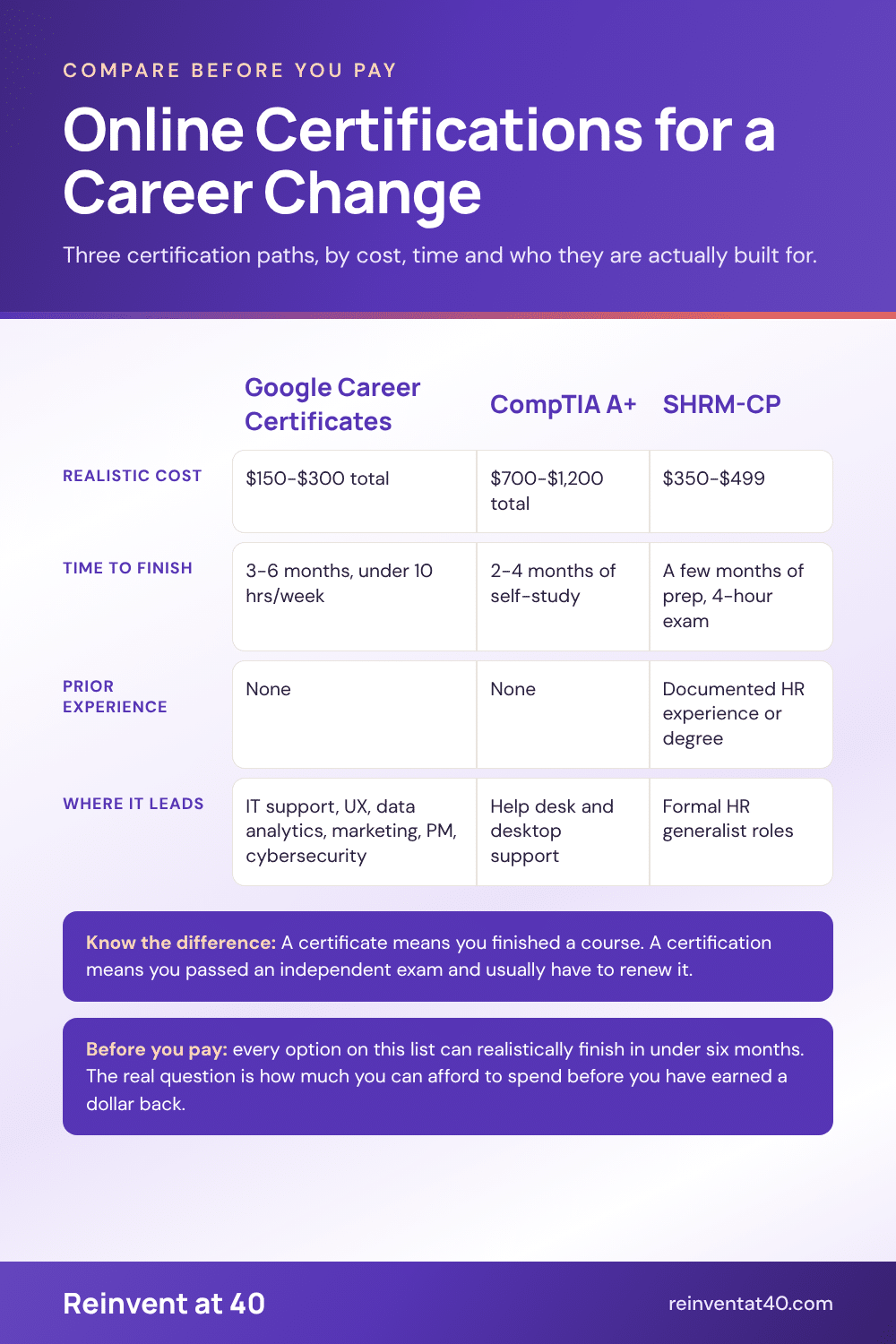
What separates a certificate from a certification
These two words get used interchangeably online, and the difference affects your wallet. A certificate, like the Google Career Certificates below, means you completed a course. No outside exam scores you, and there’s no renewal. A certification, like CompTIA A+ or CAPM, means you passed a standardized exam run by an independent organization, and you’ll usually need to renew it every one to three years to keep using the letters. Neither is automatically better. A certificate is generally cheaper and faster; a certification tends to carry more weight with a hiring manager who’s never met you, because someone else already checked your knowledge.
Six options, compared side by side
| Certification | Who runs it | Realistic cost | Time to finish | Prior experience needed | Where it leads |
|---|---|---|---|---|---|
| Google Career Certificates | Google, via Coursera | $49/month; most people spend $150-$300 total | 3-6 months at under 10 hrs/week | None | IT support, UX design, data analytics, digital marketing, project management, cybersecurity |
| CompTIA A+ | CompTIA | $530 in exam fees alone (two exams); $700-$1,200 realistic total with study materials | 2-4 months of self-study | None | Help desk and desktop support roles |
| CAPM | Project Management Institute | $225 (PMI members) to $300 (non-members); membership runs $129/year | Weeks to a few months; 23 hours of training required before you can sit the exam | None beyond a high school diploma or equivalent | Project coordinator and junior project management roles |
| SHRM-CP | Society for Human Resource Management | $350-$450 (members, depending on timing) to $450-$499 (non-members) | A few months of prep; the exam itself runs about 4 hours | Yes: documented HR-related experience and/or an HR degree | Formal HR generalist roles |
| CPC (Certified Professional Coder) | AAPC | $399 exam fee ($325 for AAPC students), plus required AAPC membership | Training programs run 4-12 months; the exam itself is 5 hours 40 minutes | None required, though a training course is strongly recommended | Medical billing and coding roles |
| Notary Signing Agent Certification | National Notary Association | $199-$249 | About 4 hours of training, plus a background check that takes 5-15 business days | Yes: an active state Notary Public commission first | Loan signing agent work |
A few things jump out once they’re side by side. Three of the six (Google, CompTIA, CAPM) assume you’re starting from nothing. Two of the six (SHRM-CP, the notary certification) assume you’re already standing somewhere adjacent, with HR experience or an existing notary commission, and formalize that footing rather than building it from scratch. And the cost spread runs from under $200 to well over $1,000 for what both call, technically, “an online certification.”

Questions worth asking before you pay for anything
How fast do you need this to turn into income? If the answer is months, not a year, that rules out anything requiring hundreds of hours of unpaid coaching or client work to reach. Every option on this list can realistically be finished in under six months, which is exactly why I chose them.
Do you already have a foothold in the field, even an informal one? A decade of handling payroll and hiring for a small business you helped run is real HR experience, even without the title, and it changes which certification is worth your money. Starting from zero calls for a different pick than formalizing what you’ve already been doing unpaid for years.
How much can you afford to spend before you’ve earned a dollar back? Google’s $49-a-month model lets you stop the subscription the moment you’re done, or the moment you decide the field isn’t for you, which makes it the lowest-risk way to test something new. CompTIA and SHRM-CP ask you to commit hundreds of dollars up front for an exam you either pass or don’t.
Does the credential travel, or is it tied to one state? Five of these six work the same way no matter where you live. The notary signing agent certification is the exception: it only makes sense once you already hold a notary commission from your own state, and notary rules vary enough by state that it’s worth checking yours before you spend a dime on the add-on certification.

Which one actually fits your situation
If you’ve spent years running the informal HR function at a small company, hiring, onboarding, handling the awkward conversations nobody else wanted, SHRM-CP turns that experience into a credential a bigger employer will actually screen for. It’s the most expensive route on a per-hour-of-study basis, but it’s built for someone who already has the harder part done.
If you have no background in tech at all and $150 to find out whether you’d tolerate a desk job troubleshooting other people’s problems, a Google Career Certificate is the cheapest way to answer that question without quitting anything first. Cancel the subscription the day you finish, or the day you realize IT support isn’t it.
If you’re already a notary handling the occasional document signing and keep hearing about loan signing agents making $75 to $200 per appointment, the NNA certification is a few hundred dollars and one afternoon of training standing between you and that work. It’s not a starting point. It’s an upgrade to something you’re already licensed to do.
If the job you’re aiming for asks for more than a certificate, online degree programs for adults explains how to judge whether a degree pays off at this stage. And if coaching is on your shortlist, life coach certification: is it worth it after 40? looks at cost, accreditation and how coaches actually find clients.
Frequently asked questions
Do employers actually care about online certifications, or is that just marketing from the schools selling them?
It depends entirely on the field and the certification. CompTIA A+ and PMI’s certifications are widely recognized by hiring managers in IT and project management specifically because they’re run by independent bodies with a standardized exam, not the company teaching the material. A certificate of completion from a course with no outside exam carries less weight on its own, but it still demonstrates initiative and gives you something concrete to talk about in an interview.
Which of these is the cheapest?
The notary signing agent certification, at $199 for the standard package, if you already hold a notary commission. If you’re counting the cost of becoming a notary first, a Google Career Certificate at roughly $150 to $300 total is usually the cheaper starting point for most people.
Which one can I finish fastest?
The notary signing agent training itself takes about four hours, though the background check adds one to two weeks. Among the ones built for people starting from zero, CAPM’s required 23 training hours can be finished in a couple of weeks if you study consistently, though most people spread it over one to two months alongside a job.
Can I use one of these to test a field, then pivot to something else entirely?
Yes, and the Google Career Certificates are built for exactly that. The subscription model means you’re not out hundreds of dollars if three weeks into UX design you realize you’d rather try data analytics instead; you just switch course tracks within the same subscription.
Do any of these expire or need renewal?
CompTIA A+ and PMI’s CAPM both need renewal, generally every three years, through continuing education hours or a renewal exam. SHRM-CP requires ongoing professional development credits to maintain. The AAPC’s CPC credential requires active membership to remain valid. Google Career Certificates and the NNA certification don’t expire the same way, though state notary commissions themselves do need periodic renewal.
None of these six turns into a job by itself. What they actually do is remove one specific excuse, no relevant background, no proof you can do the work, no formal credential a hiring system can search for, so the excuse you’re left with is a smaller one. Pick the certification that removes the excuse actually standing in your way right now, not the one with the most impressive name.
If you’re still deciding whether a certification is even the right next move, or whether a full career change makes more sense, our complete guide to career change at 40 walks through how to audit what you already have before you spend money on anything new. And if the no-degree, no-experience angle is what brought you here, our list of best careers to start at 40 without a degree covers what several of these certifications, including CompTIA A+ and the CPC, actually unlock on the job side.