
“How long is this going to take?” is usually the first question anyone reentering the workforce after 40 asks, and it’s almost never answered honestly. Career coaches love to say “everyone’s different” and leave it there. That’s true, but it’s not useful when you’re three weeks into a search with no calls back and no idea whether that’s normal or a sign something’s wrong.
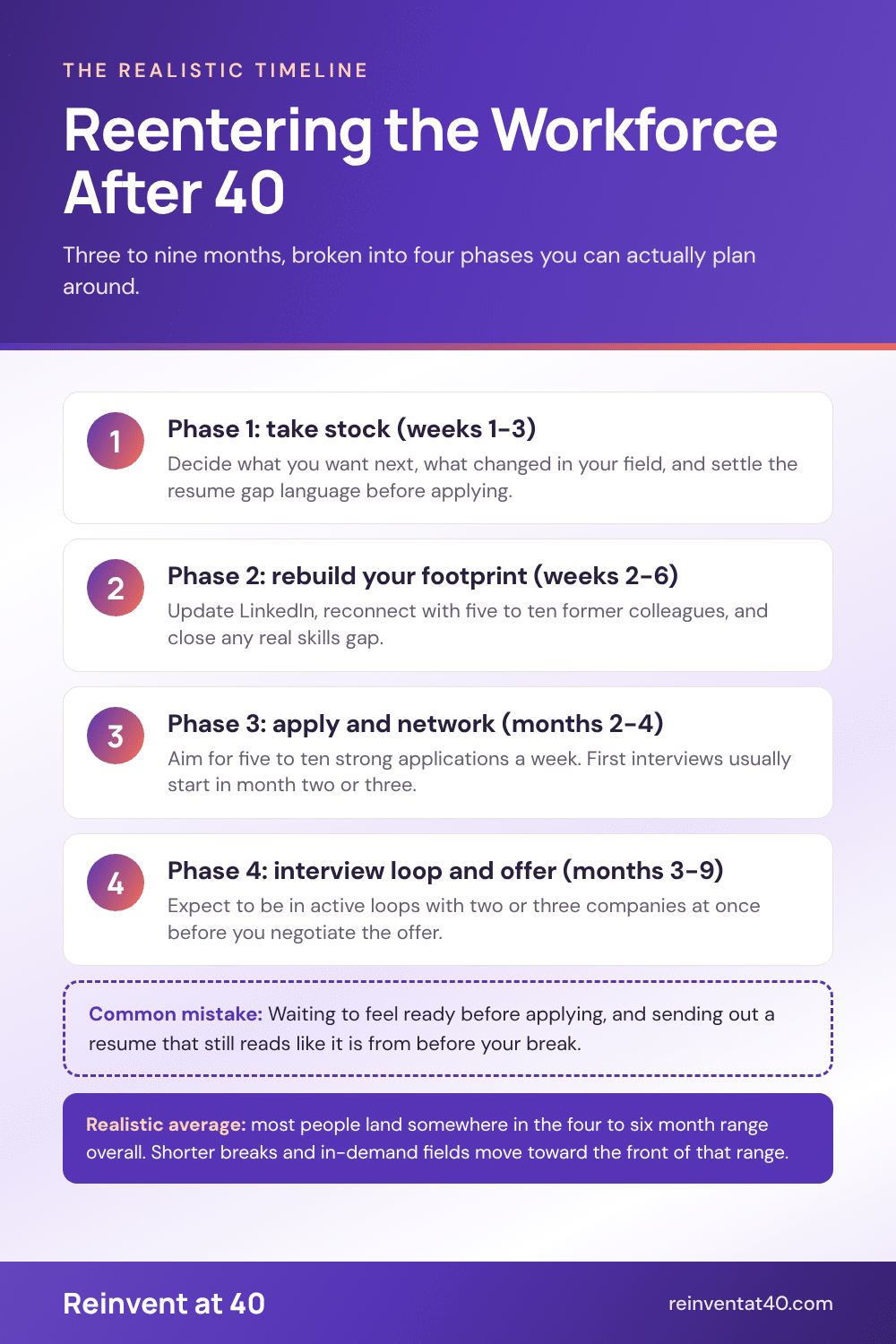
So here’s an actual answer: most people reentering after a break of a year or more take somewhere between three and nine months from “I’m starting to look” to “I have an offer I’m taking.” That’s a wide range on purpose, because where you land in it depends on a handful of specific factors, not luck. This guide walks through the phases in order, what each one actually involves, and what tends to speed things up or slow them down.
Why there’s no single number
Three things move the timeline more than anything else: how long you were out, how specialized your field is, and whether you’re aiming for the same role you left or something new. A two-year break returning to a field with steady demand (nursing, accounting, teaching) moves faster than a five-year break aiming for a different industry entirely. Neither situation is unusual. They just run on different clocks, and comparing yourself to a friend whose search took ten weeks when yours is at month four isn’t a fair comparison unless her situation actually matches yours.
If you’re specifically returning after a caregiving pause, the emotional and identity work involved adds its own timeline on top of the practical one. I’ve written separately about what that looks like after being a stay-at-home mom; this guide focuses on the operational side that applies whatever the reason for your break was. If your break was specifically from a divorce, our guide to starting over after divorce covers the added financial and timing considerations.
The four phases, in order
These phases overlap at the edges, and that’s fine. The mistake I see most often isn’t moving through them too slowly. It’s skipping straight to phase three without doing phase one, which is how people end up six weeks into applying with a resume that undersells them and a search that feels random instead of aimed.

Phase 1 (weeks 1 to 3): Take stock before you touch a job board
Before a single application goes out, spend real time answering three questions: what do you actually want to do next, what’s changed in your field while you were away, and what does your resume currently say versus what it should say. Skipping this phase doesn’t save time. It just moves the confusion downstream, into interviews where you can’t clearly answer “why this role” because you never worked it out.
This is also when you decide how to frame your time away. If there’s a gap on your resume, get the language settled now rather than improvising it under pressure later. My guide to explaining a resume gap covers exactly how to word it on the resume, on LinkedIn, and in an interview, so you’re not starting from a blank page in phase three.
Done looks like: a resume you’d actually hand to someone without wincing, a one-line answer for the gap, and a short list of target roles instead of “something in marketing, I guess.”
Phase 2 (weeks 2 to 6): Rebuild your professional footprint
This phase runs alongside phase one more than after it. It’s the unglamorous groundwork: updating LinkedIn so it doesn’t look frozen in the year you left, reconnecting with five or six former colleagues (not fifty strangers), and closing any obvious skills gap with a short course or certification if your field has moved on without you. None of this needs to be dramatic. A weekend refresher on the software your industry switched to while you were gone often does more for your confidence in an interview than a full recertification would.
Reconnecting with your network is the part people skip most, usually because it feels like asking for a favor. It isn’t. A short message asking how someone’s team is doing, with no ask attached, does more for your search over the next few months than another hour spent tweaking your resume font.
Done looks like: an updated LinkedIn profile, five to ten reconnected contacts, and any skills refresh you decided you actually needed, not every course that looked interesting.

Phase 3 (months 2 to 4): Applications, networking, and your first interviews
Now the volume starts. Plan on applying to more roles than feels efficient, five to ten strong applications a week is a reasonable pace, alongside continued networking conversations rather than instead of them. The first three or four weeks of this phase are usually quiet. That’s normal, not a signal you’re doing something wrong. Response times from employers run slower than most people expect, and a lack of callbacks in week two says very little about how week eight will go.
First interviews typically start showing up somewhere in month two or three. If you’re over 40 and the silence stretches longer than that despite steady applying, it’s worth reading my guide on dealing with ageism in job search, since some of what slows this phase down specifically for this age group is fixable with small resume and framing changes rather than a bigger overhaul.
It also helps to know what’s actually driving those hiring decisions on the other side of the table. I’ve broken that down separately in what employers actually look for when women return to work.
Done looks like: a steady application rhythm, a handful of first-round interviews on the calendar, and a tracking system (a simple spreadsheet works fine) so you know what you applied to and when to follow up.
Phase 4 (months 3 to 9): The interview loop and the offer
This is where the range widens the most, because interview loops themselves vary wildly. Some roles wrap up in two rounds over two weeks. Others run four or five rounds over six weeks, especially at larger companies with multiple stakeholders. Neither pace tells you anything about whether you’ll get the offer. It tells you about that company’s process, full stop.
Expect to be in active loops with two or three companies at once by this point, not pinning everything on one “dream” opportunity. That’s not just a numbers strategy. It also takes the pressure off any single interview, which tends to make you perform better in all of them.
Done looks like: an offer, obviously, but also the negotiating conversation that comes with it, salary, start date, and any flexibility you need for the transition back to full-time work.
What stretches the timeline, and what shortens it
A longer break, a career pivot on top of the reentry, and a narrow geographic search (only willing to work within 15 minutes of home, say) all tend to add months. A specialized or in-demand field, an active professional network you kept up during the break, and openness to a lateral or slightly smaller role as a re-entry point all tend to shave months off. That last one is worth sitting with: taking a step that isn’t your final destination, just to get back inside a company and rebuild momentum, is a legitimate strategy, not a failure.
Common mistakes that add unnecessary months: waiting to “feel ready” before applying to anything (you’ll feel readier after the first few interviews, not before); applying only to your exact previous title instead of adjacent roles; skipping phase one and sending out a resume that still reads like it’s from before your break; and treating networking as a last resort instead of running it in parallel with applications from week one.
Two steps in this timeline have their own guides: informational interviews, with a script for asking, and updating your LinkedIn profile after 40. If your time away was spent raising children, see returning to work after being a stay-at-home mom.
Frequently asked questions
What’s a realistic average for reentering the workforce after 40?
Three to nine months from the start of an active search to an accepted offer, with most people landing somewhere in the four-to-six-month range. Shorter breaks and in-demand fields land toward the front of that range; longer breaks or a career pivot land toward the back.
Should I wait until I feel fully ready before applying?
No. Readiness tends to build from doing the search, not before it. Complete phase one (resume, framing, target roles) and then start applying even if you don’t feel 100 percent confident yet.
Is it faster to go back to my exact old field, or should I consider something new?
Returning to the same field is almost always faster, because you skip the learning curve and your existing network is more directly useful. A pivot can still work well; it just tends to add one to three months for the extra research, networking, and sometimes a course or certification involved.
How many applications should I expect to send before getting an offer?
There’s no fixed number that applies to everyone, but a rough rule of thumb is that steady effort (five to ten strong applications a week, plus ongoing networking) over two to three months usually produces multiple interview opportunities. If you’ve sent significantly more than that with nothing back, the resume or targeting is worth revisiting before sending more.
Is it worth taking a part-time or lower-level role while I keep searching?
Often, yes, especially past the four-month mark. It keeps your resume current, rebuilds routine and confidence, and sometimes turns into the full-time role itself. It’s not a step backward if you’re clear with yourself that it’s a bridge, not the destination.
What if six months have passed and I still don’t have an offer?
Six months without any interviews at all usually points to the resume or targeting, not effort, and is worth a fresh set of eyes. Six months with interviews but no offer yet is different and often just means the timeline is running toward the longer end for your specific field and situation. Keep the process going rather than treating month six as a deadline for panic.
If you’re still working out the bigger direction question, not just the mechanics of the search, my complete guide to changing careers at 40 is the place to start before you build the phase-by-phase plan above around it.
There’s no version of this where the timeline is instant, and anyone promising otherwise is selling something. But three to nine months, worked through in order, is a plan. And a plan is a lot easier to live inside than an open-ended “I don’t know when this ends.”